Welcome to La Redole
Welcome to La Redole! We hope you enjoy your stay. As the house is often closed up between guests, we include detailed instructions here on how to turn everything on and get yourselves comfortable. If there was a guest here just prior to your visit, you may not have to complete all the listed steps―just skip those.
If any direction doesn’t make sense, tools are missing, or something is broken, sections later in the guide provide additional troubleshooting and guidance.
In case of emergency:
Police: Meyssac Gendarmes 05 55 25 04 03
Doctor: Cabinet Médical Barthoumeyrou (Dr. Nelken et al), Meyssac 05 55 25 42 25
Opening Up “Quick Start”
You may find all utilities turned off and disconnected to prevent frozen pipes, lightning damage, etc depending on whether there was a previous guest or not. In any case, you should verify that everything is set up correctly.
On the dining room table you should find a flashlight, matches, a pair of pliers, and a screwdriver which you will be using to open the house (if not, check the kitchen pantry in the toolbox on the floor).
Open Some Shutters
Door keys should be hanging on a nail near each door. Open the doors and shutters to let some light in!
Electricity
We usually shut off electricity at the utility cutoff panel in the back yard.

The top grey box has a latch at left that can be opened with the screwdriver. Open the box, and then all you have to do is flip the switch on (up).
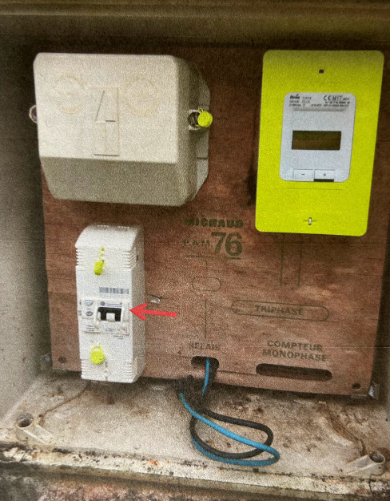
- Firmly close the door of the electrical box. Head inside, and check that the lights work.
- Plug in the refrigerator and close the door, but save the wooden block the fridge door was resting on.
Water
The water is usually left turned off and the house drained to prevent frozen and burst pipes.
- Go through the house and turn off all the taps, which are left open to let the system drain: kitchen sink, upstairs bathroom sink, downstairs bathroom sink, tub, and the outside hose bib.
- Take the flashlight and head out the back door. Go down the steps towards the field, then walk to your right along the wall of the house. Open up the doors to the “cave” and head inside.
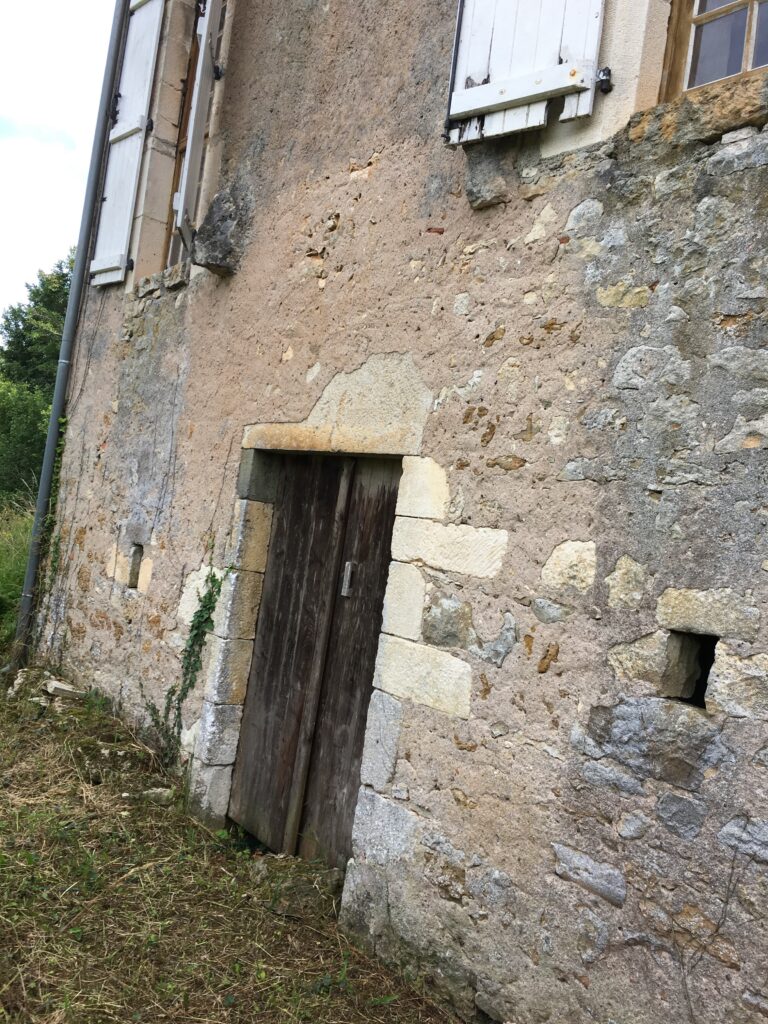
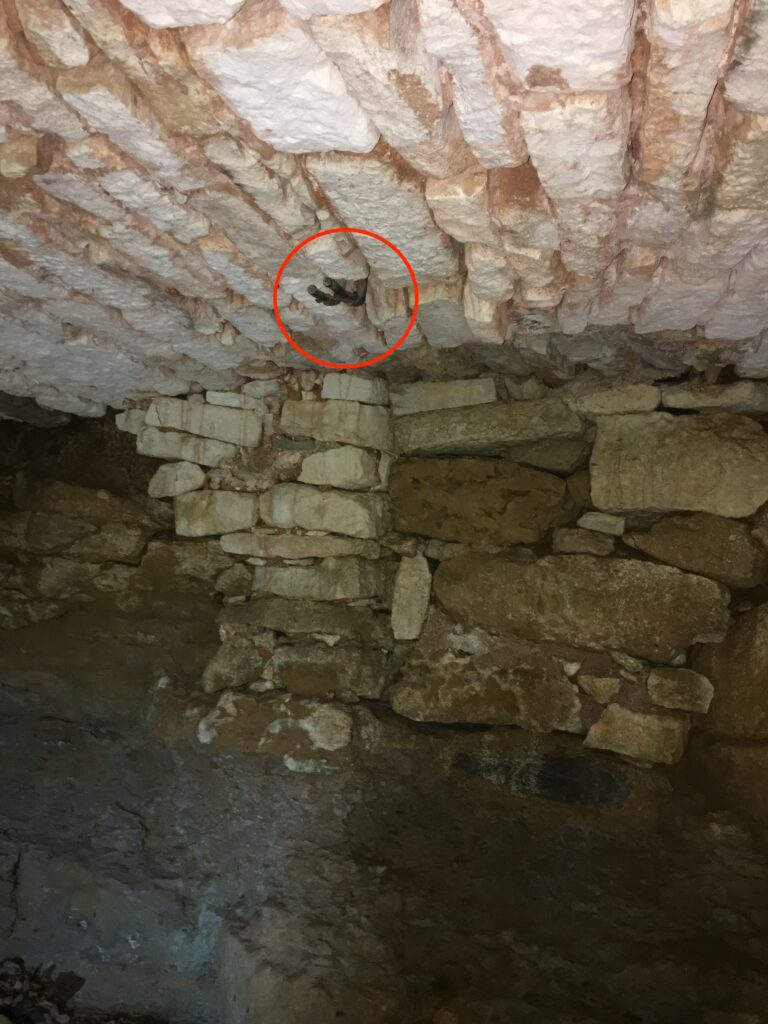
- Poking down from the ceiling towards the back you’ll find two copper pipes which are the lower system drains. At the end of these pipes you’ll find two very small thumbscrews that are loose. Screw them in (clockwise) gently – fingertight is fine – as the pipes are fragile. DO NOT LOSE THE THUMBSCREWS.
- Exit the cave, close the doors behind you, and head back up the stairs. As you come up the stairs, locate the water well in front of you.
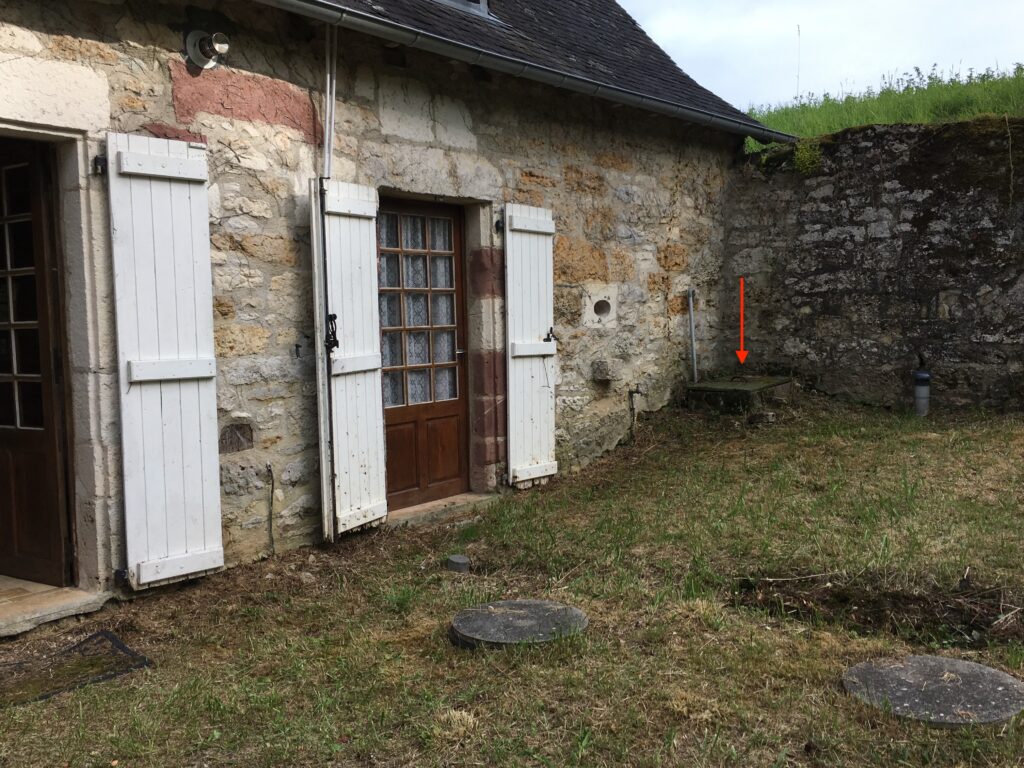
- Pull the cover off the water well, then pull out any insulation to expose the main water supply.
- Close the black vent knob (1), then open the main water valve (2).

- At this point, head inside. You should hear the toilets filling. But check each sink and the tub to make sure nothing is leaking.
Gas (Hot Water/Stove)
La Redole uses bottled propane to provide hot water and gas for the stove/oven. Two tanks are connected, with one tank in use at a time.
- Take the pliers from the kitchen table. There should be two large gas bottles in the kitchen. Bring these items outside and to your right; you will see a little hutch for the gas:
<image> - Put both gas tanks in place. Turn the tanks so that the valves and hoses point towards the back of the hutch.
- Gently attach the gas hoses to the central valve as shown, using your fingers to screw on each hose carefully (normal clockwise thread) until you are sure that the the threads are properly aligned – it’s easy to strip these threads:
<image> - Once the hoses are finger tight, use the pliers to gently tighten up the connections a bit more – an additional ¼ turn, but not too much should be needed.
- Then the central knob to point towards the bottle that is marked as “IN USE.”
- Open the valve on top of the “IN USE” bottle and listen and smell for leaks.
- If you do find a leak, you can try tightening the hose connections a bit more. Note that the bottle ends of the hoses are REVERSE THREADED. If that doesn’t work, check the Troubleshooting section later in this manual.
- Head back inside, grab the lighter/matches, and go to the stovetop. Turn on one of the burners, wait 30 seconds, and then try to light one of the burners.
- If you hear hissing but the burner won’t light, you can wait a bit more then try again.
- If you don’t hear anything, then the nearby valve may be clogged – open the cabinet to the right of the stove, find the valve on the inside left wall, and open/close the valve several times to clear the line. Try again. As before, see Troubleshooting if needed.
- On the wall behind you, to the right of the pantry, is the tankless hot water heater.
- Open the kitchen pantry, and on the inside wall behind the water heater find the electric plug for the heater. Plug it in to the nearby outlet.
- Also inside the pantry two shelves down is another gas valve. Turn the valve a few times to clear the line, and leave it with the black lines aligned vertically with the gas pipes.
- Just below the water heater, turn the yellow water supply valve a quarter turn and leave it parallel to the pipes.
- On the heater itself, turn the knob at left to the on (1) position, and wait 3 minutes.
- Go to the kitchen sink and turn the hot water (left knob) on full. You should hear the water heater come to life after a few seconds, and in a few seconds start to feel the water warm up.
- As before, see Troubleshooting if needed.
Linens
Most of the furniture in the house is covered with tarps to protect it from dust. Pull off all the tarps, fold them up, and store them in the master bedroom closet.
Find sheets, blankets, and pillows in bins either on or under the beds, or recently laundered on the kitchen table. Make up beds as necessary.
Bath towels can be found in bins on or under the shelving in the bathroom.
Enjoy
At this point, all the critical systems should be working. There’s more to learn, however, and the rest of the guide will cover additional cleanup, maintenance, and generally living in La Redole. And closing up when you leave!
Additional Opening Up Tasks
Once the critical stuff is out of the way, there are some additional opening up tasks you will want to get to while it’s still light, if possible.
- Some of the shutters may bang in the wind of they’re not held back. Retaining clips may be mounted on the walls on either side of the door/window which you can flip up to hold the shutter. There’s also a small rope between the two center shutters behind the big fireplace, and you can pull that tight to hold those shutters open.
- After the water system has been pressurized for a bit, check the sinks, tub, water heater, and the drain tubes in the “cave” under the house carefully for leaks. If there are any, and gently tightening the appropriate knob does not help, call the plumber.
- Put the insulation back in the main water will and put the cover back on.
- Use the dish soap from the kitchen and smear a little bit around both ends of the gas bottle connections outside. If there are any tiny leaks, you’ll see bubbles. You can gently try tightening the hose ends – see the Troubleshooting section below.
- In the kitchen where you found the gas bottles, you’ll find the carry handle which you’ll need when replacing a gas bottle. Put those in the gas hutch as well, and close the lid.
- Find a packet of “Bio 7” or “Eparcyl” in the downstairs bathroom, under the shelving,. Empty a packet of that into the toilet and flush.
- Find the satellite internet equipment in the loft, just at the top of the stairs.
- There’s a long grey cable attached to the router (at the top of the window) – feed this through the hole at the top right of the window (temporarily plugged with a cork) and throw the end out into the yard.
- Move the antenna (large flat white panel) into the backyard, plug it into the grey cable, then align it on the white wooden board in the middle of the yard facing away from the house:
<image> - Back in the loft, plug in the power supply.
- Wait 10 minutes, then check that the wireless network is up and working:
SSID: LaRedole Password: dgc639men
- Clean and arrange the furniture to your liking.
- Find the bag of rugs and place them around the house as needed.
- Pull the plastic off the kitchen shelves and clean the kitchen as needed. Pull out the bin of plates and arrange on the shelves.
- Use the telescoping brush to wipe away any cobwebs.
- Sweep and mop the floor. You may find little packets or dishes of pellets around – these contain rodent poison and should be swept up and discarded without handling.
Troubleshooting
Electricity/Lighting
Note that electricity in Frane is 200V and 50Hz; you should not use US appliances without checking the input ratings on the power supplieds. There are spare plug adapters at the top of the kitchen pantry, along with a full transformer for anything that cannot take 220V.
- If the electricity is not working at all, check the grey utility box in th eback yard – see the Opening Up section. Make sure the switch at the lower left is up. You can also push the ‘+’ button on the bright yellow panel and the display should show power usage stats (not errors).
- If certain circuits dojn’t work, there is a breaker panel in the opt let of the kitchen pantry. Make sure all the switches are up.
- If specici lights dont’ work, you can find spare bulbs in the op of the kitchen pantry. If more bulbs are needed, you can get from them from the hardware store: search for Guillain at Av. des Messageries, 46110 CATENA.
- For other electrical needs, call:
- M LaMothe (local handyman): cell 07 84 41 69 48 / 05 65 37 22 90
- Brive Depannage: 05 55 24 20 08
Water
- If you find any leaks you can’t fix yourself, call:
- M LaMothe (local handyman): cell 07 84 41 69 48 / 05 65 37 22 90
- Water is relatively expensive, so please address any leaks as quickly as possible.
Gas
- You should be able to hear a hissing noise when you turn on a stove burner; this indicates that the system has pressure from the gas tank. If you don’t hear anything and the stove won’t light:
- Check the outside valve to make sure it’s pointing at the “IN USE” bottle. Flip it the other way and back.
- Make sure the knob on the top of the “IN USE” tank is open all the way.
- Turn the knob inside the cabinet to the right of the stove a couple times and rap on it with your knuckles.
- If none of this works, you may be out of gas in that tank – see below.
- The hot water heater requires more gas pressure than the stove, so it may stop working even if the stove is working. If you stop getting hot water (and the light on the heater blinks red):”
- Hold down the green button at right on the heater for 10 seconds to “reset” the heater
- The fan will kick in, but if you don’t hear the “whoosh” of gas igniting there could be an issue; eventually the red light will also blink.
- Try turning and rapping on the gas valve inside the pantry, then resetting the heater again.
- If none of that works, you may be out of gas, see below.
- If you are out of gas, i.e. the water heater or stove won’t light, check the “IN USE” tank as it should feel a lot lighter. Then:
- Close the valve on the “IN USE” tank
- Sewitch the outside valve to point to the tank marked “FULL”
- Op[en the knob on the tank marked “FULL”
- Re’cehck the hose from the”GULL tank with dish soap to ensure that it isn’t leaking
- Remove the4 “FULL” label on the new tank and set it aside. Move the “ION USDE” label from the empty tank and place i=on the new tank.
- Get the pliers from the kitchen pantry. The hose attached to the empty tank (at the tank end) isd REVERSE THREDED – you should disconnect it by turning in the opposite direction from what you expect (push the plier handles in the direction indicated in the diagram below). Disconnect the hose from the empty tank at the tank end.
<image>
- Find the tank carry handle, place it over the empty tank valve, and screw it down to attach. Bring the gas tank to your car.
- Replace the gas tank at the hardware store:
Guillain at Av. des Messageries, 46110 CATENA.
You need the silver-over-blue propane tanks, as the different color tanks are not interchangeable. These are less popular these days, and sometimes even out of stock – but you can ask the store manager to order you one, may have to wait a couple days.
- Once you have a new tank, place it back in the hutch and reconnect it – remember it is reverse threaded, should be handled gentle. Leave it closed, and attach the “FULL” label to the tank.
General
If anything else in the house breaks or disappears, we appreciate you replacing it and letting us know – we’ll be happy to reimburse you for any such expenses.
Living at La Redole
The best thing about La Redole is of course the view, but you can enjoy the rest of the property and the entire region as well.
The property itself extends from the low rock wall in the back to about 20m past the driveway entrance, and down into the cow pasture enclosing the fruit trees.
<image>
From La Redole, you can easily walk into Turenne or through a series of great hikes in the surrounding countryside. Biking is a great way to tour the area (but pay attention to where the hills are!), and you can drive to castles, caves, farms, and vineyards to your heart’s content.
There are a number of guides, maps, and notes from previous visitors on the sideboard in the living room if you are looking for fun things to do. Make use of the farmer’s markets in surrounding towns to find amazing food as well.
Emergencies
Doctor: Michel Tiendas in Cressensac: 05 65 37 75 06
- Speaks some English, knows us well so mention our name
- Makes house calls
Dentist: Gaelle Chouty in Meyssac: 05 55 25 40 43
Safety
The area is generally safe, although break-ins can be a problem particularly when properties sit empty. Here are some recommendations:
- French door sets have to be turned twice; we recommend always doing so as the “single” setting isn’t fully secure.
- If you leave the house for more than an hour, lock all the doors.
- If you leave for more than a few hours, we recommend pulling the satellite antenna into the house.
- If you leave for more than a day, we recommend closing the shutters as well.
Trash and Recycling
There are anumnber of bins and buckets in the kitchen area that you can use to collect trash and recycling, and trash bags can be found in the kitchen pantry.
When you are ready to get rid of your trash and recycling, find the little key dongle which is hanging from a nail to the left of the fridge. Bring that and the trash to the school just down the road. As you come up the school, driveway you’ll see large bins to your right; use the key dongle to open the trash bin and the other bins for various recycling.
Make sure you return the key dongle to where you found it!
<image>
Fires
The fireplace in the living room and in the master bedroom both work. There should be some dry lgs in the house (replace these as you use them) and more wood stacked up in the back yard. If you start to get low on wood, “futher along the road up from Turenne, on the left, is a guy with lots of wood – ask there” ??? where??)
Heat
The house is insulated, but with single-pane glass and some drafty bits – you may need to use heaters. You will find electric heaters and a kerosene heater in the bedrooms/bathroom. If you use the kerosene heater, follow the directions carefully. You can find a bottle of kerosene under the kitchen sink.
Shopping
Most smaller stores in the region are open in the morning, close for a long lunch, and the re-open in the afternoon. You can find store hours online but they are somewhat unreliable; in particular, many restaurants stop accepting new guests well before the stated closing time.
Here are some of the stores we use regularly:
- Carrefours Barrat Lieu Dit, 46110 Le Vignon-en-Quercy: Good for staples and everyday supplies, this is a typical full-service grocery store.
- Boulangeri La fontaine Pl. du Jet d’Eau, 19500 Meyssac: Great bread, croissants, etc. Go early morning and grab breakfast.
- Regional farmer’s markets:
- Brive, inside and around the Halle George Brassens, 12 Quai Tourny, 19100 Brive-la-Gaillarde: every Tuesday and Saturday
- Meyssac, in the central square: Friday
- Martel, in the ancient covered market: Wednesday
Neighbors
Your local neighbors are wonderful people and very helpful, but naturally we don’t like to lean on them too much.
Just next door are Sylvain and Chlotilde and their children. Just beyond them is Marie-Claude, who keeps our key.
Closing Up
Closing up the house is a lot like opening up in reverse. The process can take some time if you are fully closing the house for the seasons – plan for a couple hours. If another guest will be coming after you, we will tell you which steps you can skip.
- Day before: check if any food staples (salt, olive oil, etc in the kitchen pantry) are running low; check that there are at least a dozen packets of rodent poison (pantry, on floor). Replace any low stock.
- Empty the fridge, then unplug it and leave the door open. Use the wooden block to hold the door up so it doesn’t sag. Place a tray under the freezer to catch melting ice, then let it defrost.
- If you have any food leftovers in good condition, you can give them to the neighbors.
- Throw everything else perishable into the trash.
- Find the sachets stored in the plastic bins with the clean linens; these contain silica gel, Place these in a warm 100 oven to dry out.
- Gather up all the laundry (bed sets and towels etc) in the grey plastic basket. Leave 40 Euros on top, and leave on the kitchen table.
- Seal and store any non-perishable staples in the kitchen pantry.
- Clean and sweep all floors. If you can mop as well, we (and the next guest) will appreciate it.
- Clean the stove, sink, and countertops. Put all plates in the large bin. Cover the shelves with a tarp.
- Clean the bathrooms.
- Cover the beds and furniture with tarps,.
- Put all the clean linens in bins with at least one silica gel sachet.
- Lay a fire for the next guest, and make sure there’s enough wood inside the house.
- Place packets of rodent poison around the house – upstairs and down, under furniture, in closets, etc.
- Take all trash and recycling up to the bins at the school.
- When you no longer need gas, shut it down:
- Turn off the water heater (dial to “0”).
- Unplug the water heater inside the kitchen cabinet.
- Close the knob on top of the “IN USE” gas bottle outside.
- Disconnect the hosts from the wall-mounted valve (normally threaded) but leave the hoses attached to the bottles.
- Bring the gas bottles inside, along with their carry handles.
- When you no longer need water:
- Uncover the water well in the backyard and pull out the insulation; turn off the main water valve.
<image> - Inside the house, open up all the sink taps and the tub.
- Go back into the cave under the ghouse and find th drain pipes in the ceiling. VERY CAEFULLY unscrew the thunbscrews about ¼ turn, just enough for them to start to drip – but do NOT remove them entirely.
- Back in the water well, open the black vent knob.
- Open the outside hose bib near the water well.
- To be continued… but let the system drain for a bit.
- Uncover the water well in the backyard and pull out the insulation; turn off the main water valve.
- When you don’t need electricity, take the screwdriver and head out to the electrical enclosure outside. Open the cabinet and turn off the main power switch; close the cabinet tightly.
- Close the outside hose bib and re-cover the water well (re-pack with insulation).
- Put one packet of “Bio 7” or “Eparcyl” in the downstairs toilet and flush.
- Flush both toilets until they are empty of water. Add a packet of anti-freeze gel (under bathroom shelf) in each toilet bowl.
- Leave on the dining room table: this guide, flashlight, matches and lighter, screwdriver, and the pliers.
- Close all the shutters and secure with wire as needed; close and double-lock all the doors. Place keys on the hooks near each door.
- Return the key to Marie-Claude.
Enjoy your trip home!